







Products in the cart

Relaxing in nature is a wonderful opportunity to unwind, enjoy fresh air, and the beauty of the surrounding environment.
Relaxing in nature is a wonderful opportunity to unwind, enjoy fresh air, and the beauty of the surrounding environment. However, this relaxation is often disrupted by annoying insects, especially mosquitoes and midges. They not only cause discomfort with their bites, resulting in itching and irritation, but they can also seriously spoil the time spent outdoors. In some regions, especially near water bodies and in wooded areas, the population of mosquitoes and midges can be very large, making protection from them critically important for a comfortable outdoor experience. Additionally, insect bites can trigger allergic reactions and inflammation in some individuals. Therefore, effective protection against bothersome insects is an important task for anyone who wants to fully enjoy their time spent in nature.
Features of mosquito and midges vision
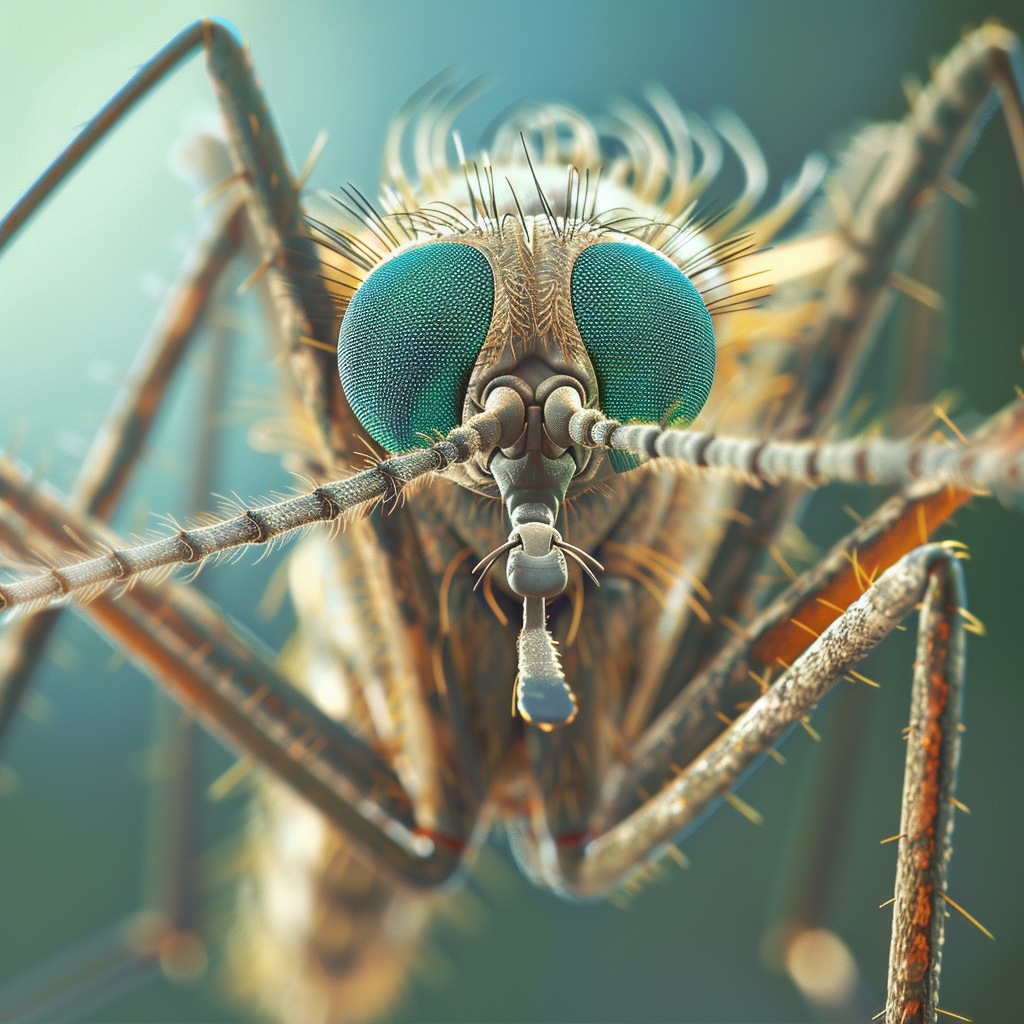
To understand how to protect oneself from mosquitoes and midges, it is necessary to understand the peculiarities of their vision. These insects, like most others, have complex compound eyes composed of numerous small units called ommatidia. This structure allows them to have a wide field of view and distinguish movement well, but it limits color perception. Their eyes perceive:
- ultraviolet,
- blue, and
- green portions of the spectrum.
However, red light is practically invisible to them. According to recent studies, light with a wavelength longer than 620 nm is not perceived by the eyes of most animals and insects. (Wang et al., 2021).
What is a light wavelength?

To understand why red light protects against insects, you need to understand what a wavelength is. Light is an electromagnetic wave characterized by a certain length. The wavelength is the distance between two consecutive wave crests or troughs, i.e. between the peaks of electromagnetic oscillations. It is measured in nanometers (nm).
Light visible to humans covers a range of approximately 380 to 780 nm. In this range, we distinguish colors:
- 380-450 nm – violet
- 450-485 nm – blue
- 485-500 nm – cyan
- 500-565 nm – green
- 565-590 nm – yellow
- 590-625 nm – orange
- 625-740 nm – red
Wavelength 667 nm and its perception by insects
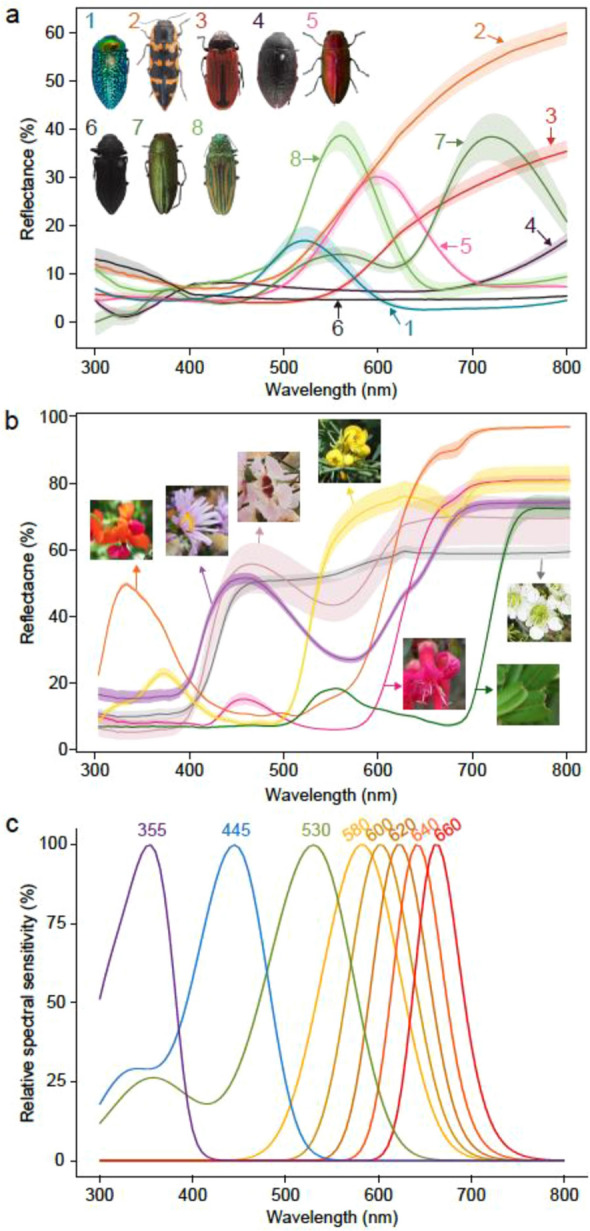
This illustration shows three graphs that were used to computer simulate how beetles and plants appear to insects.
Graph (a) shows how different colors of beetles reflect light. Each line corresponds to a certain species of beetle. For example, the blue line represents the Stigmodera gratiosa beetle, and the red line represents the Castiarina erythroptera beetle.
Graph (b) is similar to graph (a), but it illustrates how leaves and flowers of different plants reflect light. For example, the orange line represents the Chorizema cordatum plant, and the white line represents the Leptospermum liversidgei plant.
Shaded areas around the lines on graphs (a) and (b) indicate how much colors in beetles or plants of the same species can vary.
Graph (c) shows how sensitive insect eyes are to light of different colors. Each line corresponds to a specific type of cell in the insect’s eye that reacts to light. Peaks on the lines indicate which color these cells are most sensitive to.
Light with a wavelength of 667 nm, used in Kilnex lanterns, falls in the red part of the spectrum, closer to its far edge. This is beyond the visibility range of most insects.
Model experiments described in a 2022 scientific article (Lu-Yi Wang/PMC8770459), showed that:
- Color contrast for insects sharply decreases with a wavelength of the light source above 640 nm.
- Light with a wavelength of 660 nm and above practically merges with darkness for insects.
- The optimal wavelength to minimize insect attraction is around 660-670 nm.
Therefore, red light from 640 nm and above will be practically invisible to midges and mosquitoes, and 667 nm is the ideal wavelength for this purpose.
Why red light doesn’t attract insects

Now that we know the peculiarities of insect vision, it becomes clear why they flock to the usual white light of streetlights but ignore red light:
- Insects are primarily attracted to ultraviolet and blue light. They associate these parts of the spectrum with the open air and water, the places where they look for food and lay their eggs.
- In the spectrum of natural lighting (sunlight, sky reflection), blue and ultraviolet waves prevail, while there are much fewer red waves.
- Therefore, red and far-red light (> 640 nm) appear as darkness to insects, not attracting their attention.

KILNEX CAMPING FLASHLIGHT FOR BATTERY POWERED EMERGENCY LIGHTING, RECHARGEABLE TYPE-C WHITE LIGHT + RED 2600 (IP 67)
in stock
Innovative powerful flashlight with a 2600 mAh rechargeable battery + additional red light
37.99 €
buy
Leave feedback
 (20)
This item is currently being viewed 10 user
(20)
This item is currently being viewed 10 user
(20)
This item is currently being viewed 10 user
Additionally, some flashlights, such as the innovative powerful camping flashlight from KILNEX, “WHITE LIGHT + RED 2600,” equipped with a reinforced 2600 mAh battery and additional red light, feature special functions for protection against insects.

For example, this powerful flashlight has an ultraviolet lamp that attracts flying insects inside the device. There, they encounter a metal grid under voltage, upon contact with which the insects instantly perish. This ensures the safe and effective extermination of mosquitoes and other annoying flying insects in the illuminated area of up to 10 square meters, especially indoors without additional light sources.
Benefits of Kilnex lights with 667 nm wavelength
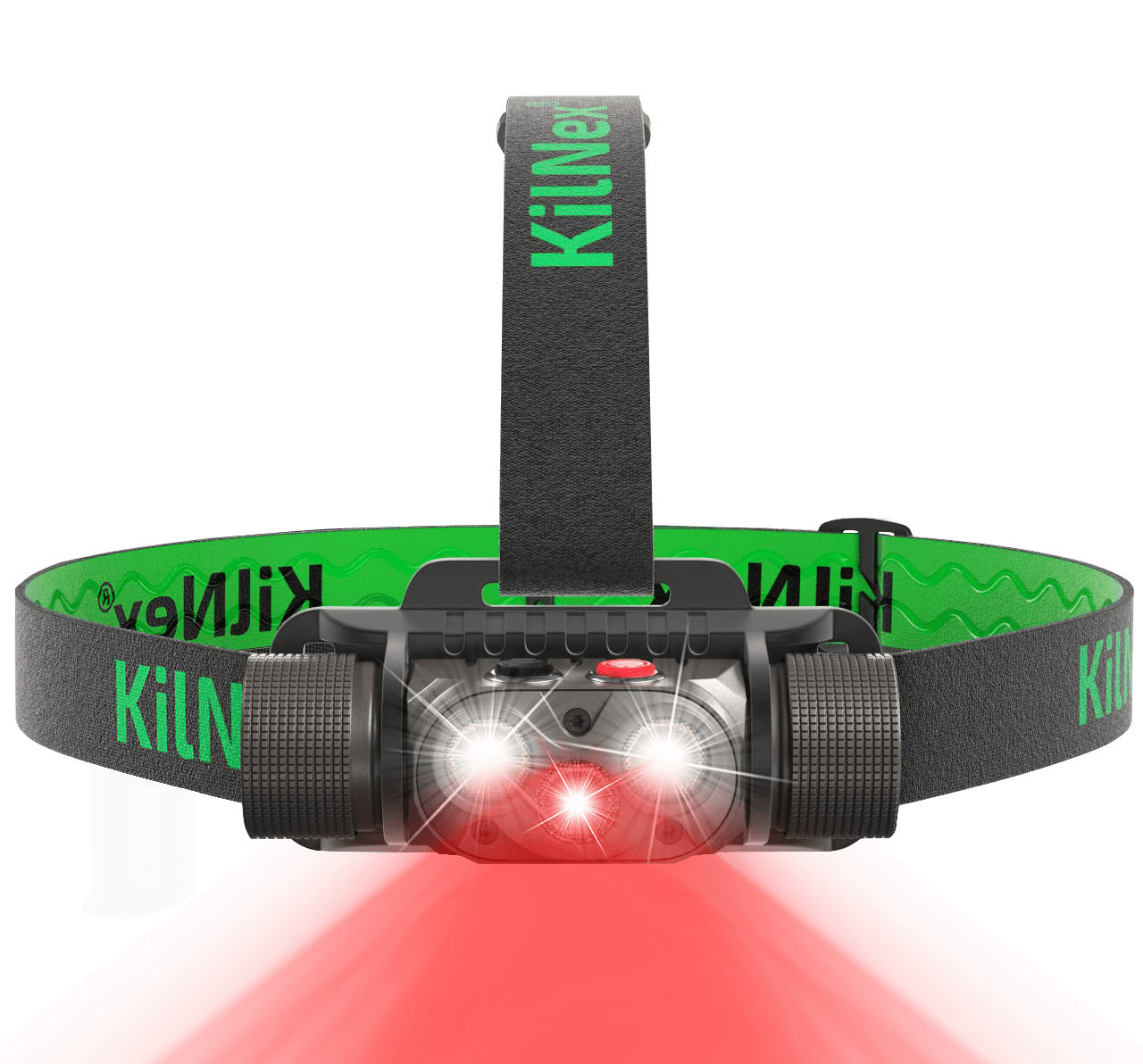
Kilnex flashlights are specifically designed with these scientific data in mind to provide maximum protection against insects. They have unique advantages:
- Special LED with a peak emission at 667 nm. According to research, this is the optimal wavelength to remain unnoticed by insects while providing sufficient light for human comfort.
- Narrow emission spectrum. This minimizes the intensity of the visible part of the spectrum (< 640 nm) to further reduce the attractiveness of the flashlight to insects.
- High brightness and wide illumination angle. The powerful LED and well-designed optics allow for effective lighting of a large area, which is crucial in outdoor conditions.
- Durable waterproof housing. The flashlight is resistant to moisture, shocks, and dirt, making it reliable in outdoor environments.
- Compactness and portability. Ergonomic design makes the flashlight comfortable to use and easy to carry.
Experience of using red lights in nature

Numerous field trials and user feedback confirm the effectiveness of Kilnex red flashlights in insect protection:
- Tourists note that they can dine peacefully by the campfire or read in the tent without fear of attracting a swarm of mosquitoes.
- Anglers appreciate the opportunity for night fishing and setting up camp without the annoying buzzing of mosquitoes around their ears.
- Hunters can comfortably track prey at night without being distracted by insects.
- Outdoor enthusiasts engaging in nighttime photo sessions can rest assured that mosquitoes won’t ruin their shots or crawl into the lens.
Moreover, the powerful red light of the flashlight does not affect night vision or disrupt circadian rhythms, unlike bright white light.
Comparison with other methods of protection
A red lantern is not the only one, but it is one of the most convenient and effective methods of protecting yourself from insects in the wild. Let’s consider its advantages in comparison with other popular means:
- Repellents, sprays, and ointments. Chemicals repel insects, but require application to the skin, often have an unpleasant odor, and can cause allergies. The flashlight works at a distance without contact with the body.
- Protective clothing (nets, impregnation). It mechanically blocks insects, but can be uncomfortable in the heat and requires special care. The flashlight does not hinder movement.
- Mosquito coils and spirals. Provide protection in a small area, require consumable materials, and are not very healthy. The flashlight is environmentally friendly and safe.
- Ultrasonic repellers. Their effectiveness has not been scientifically proven, and they can also irritate pets. The red light acts on insects in a targeted manner.
Therefore, the red light does not compete with, but complements and enhances the effect of other means of protection at a lower cost and side effects.
How to choose a flashlight with the optimal wavelength

When choosing a flashlight for insect protection, pay attention to the following parameters:
- Szczytowa długość fali promieniowania. Nie powinna być niższa niż 640 nm, a najlepiej około 660-670 nm, jak w latarkach Kilnex. Im wyższa długość fali, tym lepiej.
- Szerokość widma promieniowania. Im jest ono węższe, tym mniej światła będzie odbierane przez owady. Widmo powinno być przesunięte w kierunku czerwonej części tak bardzo, jak to możliwe.
- Moc i kąt oświetlenia. Wybierz latarnię o wystarczającej jasności i szerokiej wiązce, aby wygodnie oświetlić przestrzeń wokół siebie.
- Żywotność baterii. Podczas wędrówek ważne jest, aby latarka działała wystarczająco długo bez konieczności ładowania. Należy zwrócić uwagę na pojemność baterii
- Trwałość i ochrona przed wilgocią. Latarka musi być w stanie wytrzymać warunki użytkowania w terenie – deszcz, wiatr, upadki, zmiany temperatury.
- Peak wavelength of radiation. It should not be lower than 640 nm and ideally close to 660-670 nm, as in Kilnex flashlights. The higher the wavelength, the better.
- Width of the emission spectrum. The narrower it is, the less light will be perceived by insects. The spectrum should be shifted as much as possible towards the red part.
- Power and beam angle. Choose a flashlight with sufficient brightness and a wide beam to comfortably illuminate the space around you.
- Battery life. In outdoor activities, it is important for the flashlight to work long enough without recharging. Pay attention to the battery capacity.
- Durability and waterproofing. The flashlight should withstand outdoor conditions – rain, wind, falls, temperature changes.
Kilnex flashlights meet all these requirements and are one of the best choices for insect protection.
Conclusion
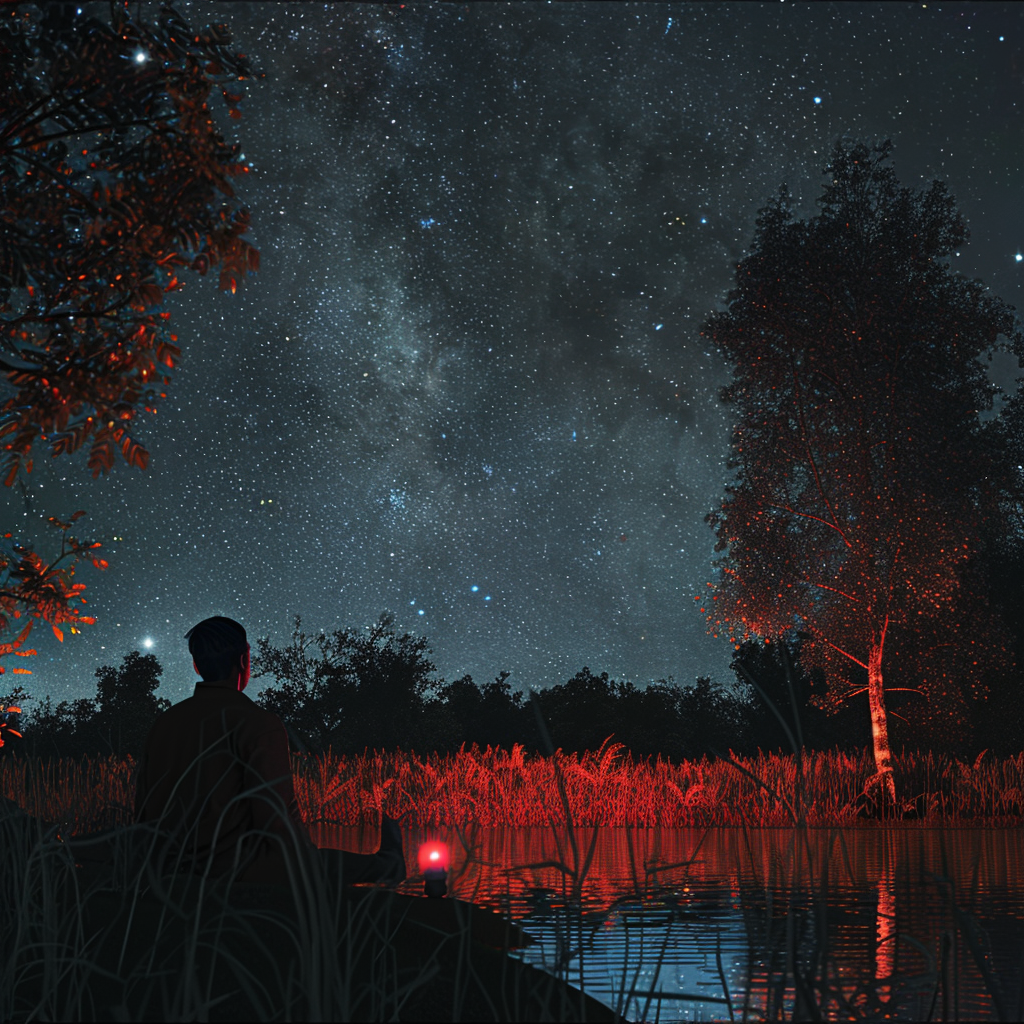
In conclusion, it can be confidently stated that the red light with a wavelength of 667 nm, used in Kilnex flashlights, is a scientifically grounded and proven practical protection against annoying mosquitoes and midges in nature.
Thanks to the peculiarities of insect vision, such light remains practically unnoticed by them, without attracting their attention. At the same time, it provides sufficient illumination for comfortable human activities during dark hours.
Using a red flashlight allows you to:
- Enjoy nighttime relaxation in nature without being distracted by buzzing and bites.
- Provide insect protection for the entire group without using chemicals.
- Complement and enhance the effectiveness of other protection methods.
- Save on consumable materials for repellents.
- Preserve night vision and maintain a healthy circadian rhythm.
Take a Kilnex red flashlight with you on hikes, fishing trips, or hunting expeditions, and mosquitoes and midges will no longer bother you! Experience for yourself how much more comfortable your nighttime outdoor adventures will become.
Sources:
Wang, L.I., Stewart-Fox, D., Walker, G., Roberts, N.W., & Franklin, A.M. (2021). Visual sensitivity of insects to long wavelengths enhances color contrast of insects against a background of vegetation. Scientific Reports, 11(1), 1-11.
https://blog.heliusworld.com/science-red-light-night-vision-preservation/
https://royalsocietypublishing.org/doi/10.1098/rsos.210415